


Insights
Atlassian's usage-based pricing: Time to rethink Jira Automation
04
Sep
2026


As a maker of pioneering water and housing products, LIXIL relies on Jira to support a wide range of business-critical processes. From service management and user access requests to logistics and cross-project collaboration, Jira workflows help coordinate work across multiple teams.
But as these processes evolved, LIXIL reached the limits of Jira’s native workflow capabilities.
There were only few out-of-the-box workflow features available. We either had to build complex workarounds in Automation where possible or do manual work.
Instead of supporting the business, workflows increasingly required administrators and users to compensate for missing automation through manual updates, repetitive ticket creation, validation checks and additional process controls.
The more workflows grew, the more difficult they became to maintain consistently.
To overcome these limitations, LIXIL introduced Jira Workflow Toolbox (JWT).
Rather than replacing Jira, JWT became the logic layer that allowed the team to extend workflows with automation, validation and dynamic behavior directly where work happens.
Today, JWT powers hundreds of workflow functions across LIXIL’s Jira environment, automating repetitive activities that previously required significant manual effort.
Some of the most impactful automations include:
Instead of relying on users to remember every process step, JWT quietly performs these actions in the background.
Perhaps the biggest transformation wasn’t simply automation—it was changing how workflows behave.
LIXIL describes the evolution like this:
Using conditions, validators and workflow logic, workflows now react to business context rather than following a single static path.
This makes processes easier to use while ensuring governance and data quality are enforced automatically.
For LIXIL, the biggest benefit has been productivity.
According to an internal assessment, JWT saves more than 2,400 hours every month—significantly streamlining operations and eliminating a substantial volume of repetitive manual steps across teams.
But the value goes beyond time savings:
As one team member summarized it:
The biggest thing we’d miss is the comfort of not having to think about certain actions because they’re executed automatically in the background.
One of LIXIL’s favorite JWT implementations supports user access requests.
The workflow combines sophisticated conditions, validators and post functions to ensure requests are routed correctly, validated automatically and processed consistently.
Another example comes from Logistics.
Previously, the process required employees to manually ensure that roughly a dozen workflow steps happened in the correct order while validating user input throughout the process.
JWT now orchestrates the entire sequence automatically, significantly reducing manual oversight while ensuring every required step is completed correctly.
Asked which JWT capability delivers the highest business value, LIXIL points to one feature without hesitation:
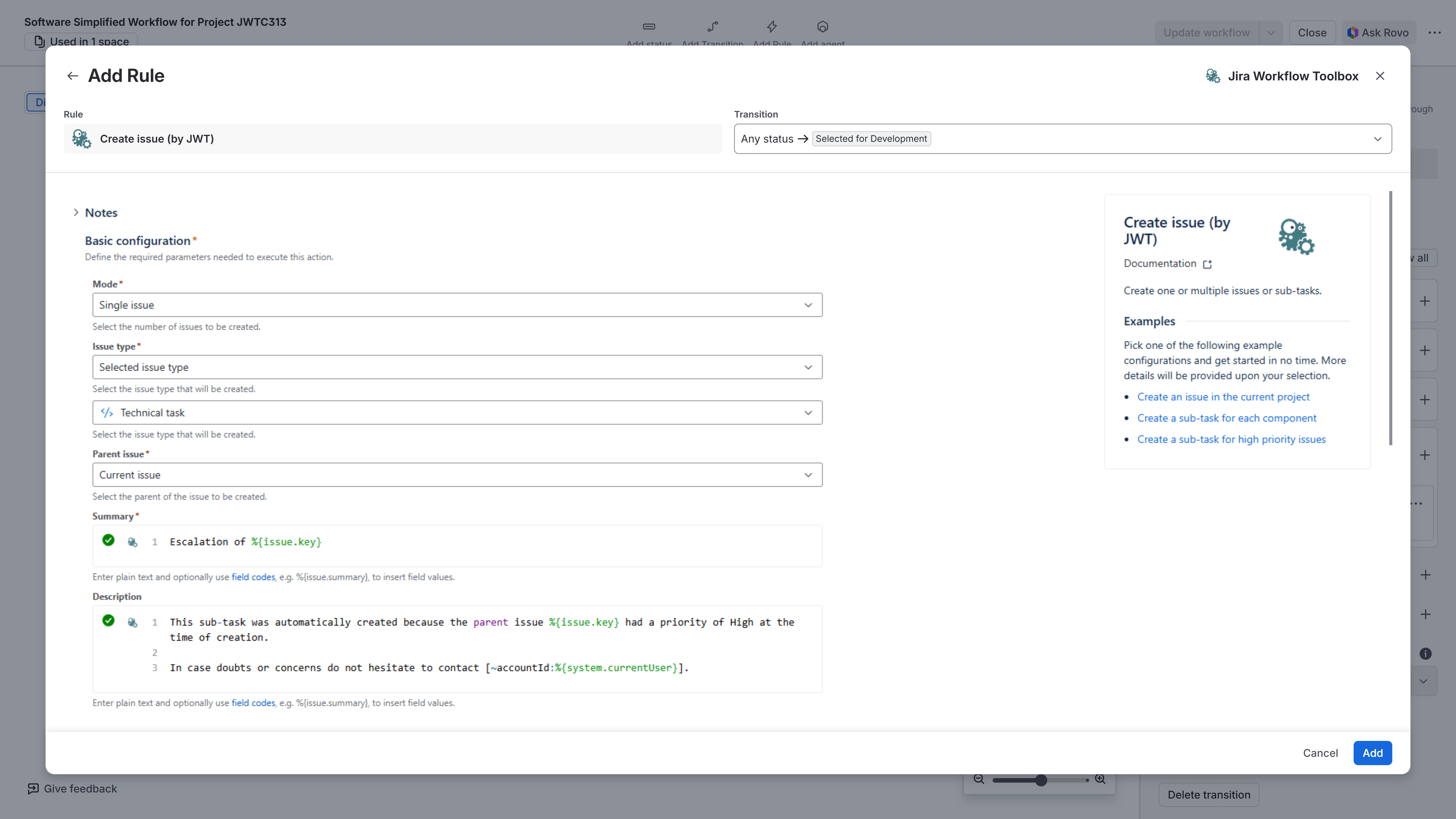
Create issue
Automatically generating linked work items allows complex processes to split into smaller workflows while maintaining full traceability across projects.
Instead of manually creating follow-up tickets, downstream teams receive their work immediately—with all required context already included.
What advice would LIXIL give to organizations facing similar workflow challenges?
The answer was refreshingly simple.
Consider introducing JWT.
LIXIL continues to expand workflow automation as new business requirements emerge.
Rather than automating for automation’s sake, new JWT functions are introduced whenever they provide the best solution for a business process.
That pragmatic approach has helped JWT become not just another Jira app, but a foundational part of how enterprise workflows operate across the organization.
Das Komplettpaket an Tools für Jira Cloud, um Prozesse mühelos zu automatisieren - von einfachen Anforderungen bis hin zu hochkomplexen Geschäftsabläufen.
Wir sind immer auf der Suche nach talentierten Menschen, die Lust auf digitale Herausforderungen haben.
Deine Stelle ist nicht dabei? Meld dich trotzdem, wenn du denkst, dass du den Unterschied machen kannst!






.avif)








.avif)
.avif)


.avif)






.avif)





.jpeg)
![Last Log for Jira – Troubleshooting easier than ever [incl. Video]](https://cdn.prod.website-files.com/6400aa62efc52f275fa918d4/65aa7d8167dd440c0529c08e_Last%20Log%20for%20Jira_The%20key%20to%20troubleshooting%20in%20Jira.gif)









.jpg)











.avif)